LumArray, Inc. is developing a tool for microlithography that based on technology that was developed over the course of several years in the NanoStructures Laboratory at MIT. The technology is called Zone-Plate-Array Lithography (ZPAL). In contrast to the lithography techniques used in the semiconductor industry and in research, namely optical-projection lithography (OPL) and contact lithography (CL), LumArray's ZPAL tool does not employ a mask; that is, it is "maskless." This enables rapid turn around on designs and economic manufacturing when only small volumes are requires.
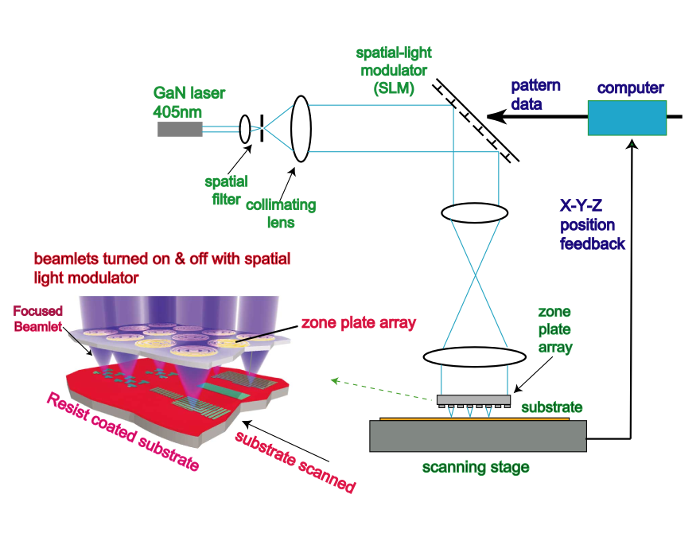
The following figure illustrates schematically the basic components and principles of ZPAL. The system is composed of: a source of collimated, continuous radiation; a spatial-light modulator; some relatively simple optics that interface the output of the spatial-light modulator to a large array of diffractive-optical lenses (in most cases, phase zone plates); and a moveable stage. Each pixel of the spatial-light modulator directs a beam of light to a specific diffractive-optical lens (DOL), and each DOL focuses that light to a diffraction-limited spot on the substrate. By intelligently controlling the output of the spatial-light modulator, in coordination with the raster scanning of the stage, complex patterns of any arbitrary geometry can be written in a "dot-matrix" fashion. The raster scan can extend over the entire substrate, or any fraction thereof. Modern high-speed computation and spatial-light modulation make dot-matrix printing feasible; ZPAL takes advantage of these modern innovations.
Fig. 1: Schematic depiction of zone-plate-array lithography (ZPAL), invented at MIT and being commercialized by LumArray, Inc.
A CW laser source illuminates a spatial-light modulator (Silicon Light Machines) containing 1000 pixels. Each pixel controls the level of light
to one zone plate of the array, adjusting the intensity from zero to the maximum in a quasi-continuous manner, enabling grey-tone control of linewidth.
By moving the stage under computer control, patterns of arbitrary geometry can be written in a dot-matrix fashion.
The spatial-light modulator is a key component of ZPAL. It must control the intensity of the light to a given DOL in a quasi-continuous manner, from fully off to fully on. This quasi-continuous control allows gray-level scaling, which in turn enables one to control feature size (e.g., a linewidth) to a much finer degree than the point-spread function of the focal spot of an individual DOL. Feature-size control to the sub-nanometer level appears feasible using gray-level scaling and zone-plate-focused 405 nm radiation.
Further details on ZPAL, including its early development at MIT, can be found at the following references:
- H.I. Smith, "A Proposal for Maskless, Zone-Plate-Array Nanolithography," J. Vac. Sci. Technol. B 14, 4318-4322 (1996).
- I. Djomehri, T. Savas, and H.I. Smith, "Zone-Plate-Array Lithography in the Deep Ultraviolet", J. Vac Sci. Technol. B, 16(6), 3426-3429, (1998).
- D.J.D. Carter, D. Gil, R. Menon, M. Mondol and H. I. Smith, "Maskless, Parallel Patterning with Zone-Plate Array Lithography (ZPAL)," J. Vac. Sci. Technol. B 17(6) 3449-3452 (1999).
- D. Gil, R. Menon, D. J. D. Carter and H. I. Smith, "Lithographic Patterning and Confocal Imaging with Zone Plates, "J. Vac. Sci. Technol. B 18(6), 2881-2885, (2000).
- D. Gil, D.J.D. Carter, R. Menon, X. Tang and H. I. Smith, "Parallel maskless optical lithography for prototyping, low-volume production, and research", J. Vac. Sci. Technol. B 20(6), 2597-2601 (2002).
- D. Gil, R. Menon, and H. I. Smith, "The Case for Diffractive Optics in Maskless Lithography", J. Vac. Sci. Technol. B 21(6), 2810-2814 (2003).
- D. Gil, R. Menon and H. I. Smith, "Fabrication of High-Numerical-Aperture Phase Zone Plates with a Single Lithography Exposure and no Etching," J. Vac. Sci. Technol. B 21(6), 2956-2960 (2003).
- R. Menon, A. Patel, E. E. Moon, and H. I. Smith, "Alpha-prototype system for zone-plate-array lithography," J. Vac. Sci. Technol. B 22(6), 3032-3037 (2004).
- R. Menon, E. E. Moon, M. K. Mondol, F. J. Castano, and H.I. Smith, "Scanning-spatial-phase alignment for zone-plate-array lithography", J. Vac. Sci. Technol. B 22(6), pp. 3382-3385, Nov/Dec (2004).
- Dario Gil, Rajesh Menon, H. I. Smith, "The promise of diffractive optics in maskless lithography", Microelectronic engineering, 73-74, 35-41 (2004).
- R. Menon, D. Gil, G. Barbastathis, and H. I. Smith, "Photon-sieve lithography", J. Opt. Soc. Am. A 22 ( 2), 342-345 (2005).
- R. Menon, A. Patel, D. Gil, and H. I. Smith, "Maskless lithography", Materials Today, pp. 26-33, February (2005).
- D. Chao, A. Patel, T. Barwicz, H.I. Smith, and R. Menon, "Immersion Zone-Plate-Array Lithography," J. Vac. Sci. Technol. B 23(6), 2657-2661 (2005).
- R. Menon, D. Gil, and H. I. Smith "Experimental Characterization of Focusing by High-Numerical-Aperture Zone Plates", J. Opt. Soc. Amer., 23 (3), 567-571 (2006).
- H. I. Smith, R. Menon, A. Patel, D. Chao, M. Walsh, and G. Barbastathis, "Zone-plate-array lithography: a low-cost complement or competitor to scanning-electron-beam lithography," Microelectronic Engineering, 83, 956-961 (2006).
- M.D. Galus, E.E. Moon, H.I. Smith, and R. Menon, "Replication of diffractive-optical arrays via step-and-flash nano-imprint lithography," J. Vac. Sci. Technol. 24(6), 2960-2963 (2006).
- R. Menon and H. I. Smith, "Absorbance-modulation optical lithography," J. Opt. Soc. Amer. A 23, 2290-2294 (2006).
- H-Y. Tsai, H. I. Smith, and R. Menon, "Fabrication of spiral-phase diffractive elements using scanning-electron beam-lithography," J. Vac. Sci. Technol. B 25, pp. 2068-2071 (2007).
- R. Menon, H.-Y. Tsai, and S.W. Thomas III, "Far-Field Generation of Localized Light Fields using Absorbance Modulation," Phys. Rev. Lett., 98, 043905 (2007).
- T. L. Andrew, H-Y. Tsai, and R. Menon, "Confining Light to Deep Subwavelength Dimensions to Enable Optical Nanopatterning," Science 9 April 2009 (10.1126/science.1167704).
- R. Menon, P. Rogge, and H-Y. Tsai, "Design of Diffractive Lenses that Generate Optical Nulls without Phase Singularities," J. Opt. Soc. Am. A. 26(2), p.297-304 (2009).